

PQSecure™ HW/SW Co-Design
Integrated architectures
Tightly integrated hardware and software cryptographic architectures, engineered for secure lifecycle management and long-term post-quantum migration.
Algorithm coverage
| Module | Standard | Status |
|---|---|---|
| ML-KEM | FIPS 203 | Available |
| ML-DSA | FIPS 204 | Available |
| SLH-DSA | FIPS 205 | Available |
| FN-DSA | FIPS 206 | Coming |
| XMSS, LMS | Stateful hash | Available |
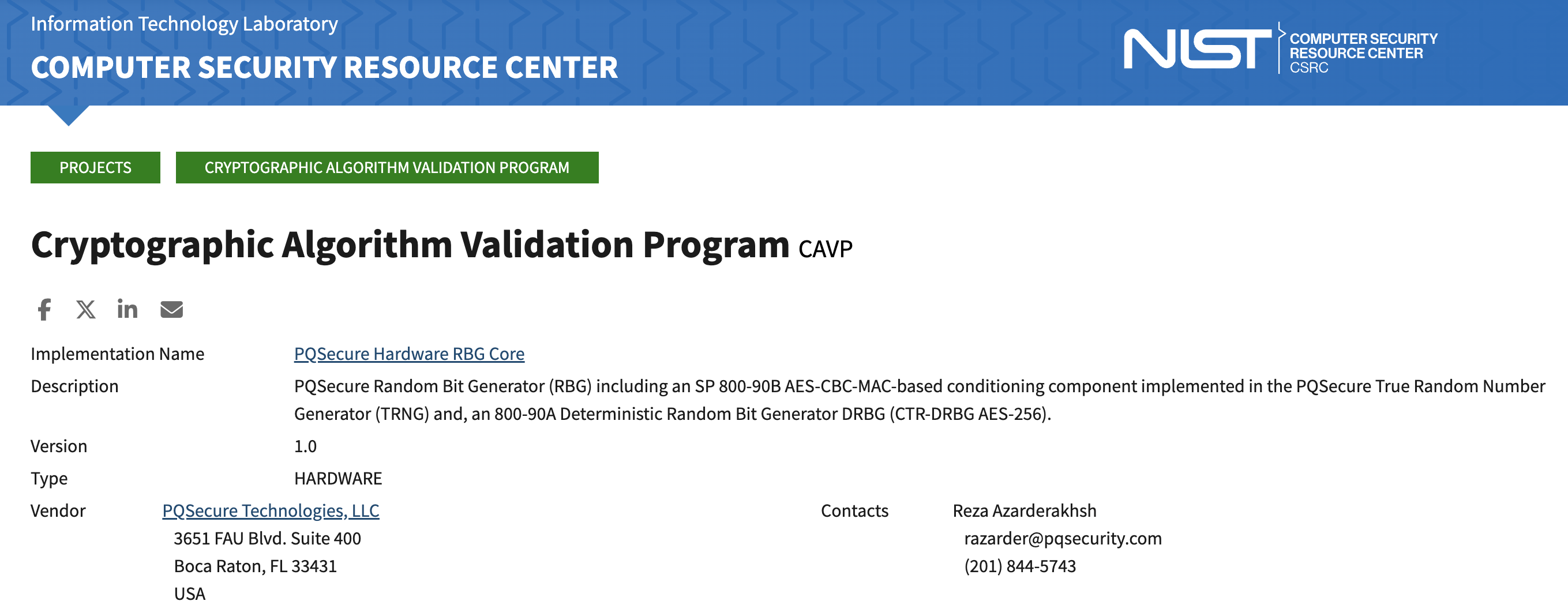
| RBG / TRNG | SP 800-90A and SP 800-90B | CAVP A8932 |
Change the cryptography without changing the silicon
Crypto agility is the ability to upgrade, replace, or hybridize cryptographic algorithms without redesigning hardware.
A standalone accelerator fixes its algorithms at tape-out. A pure software stack gives up the throughput. Designing the two together is what makes the transition from RSA and ECC, through hybrid operation, to pure post-quantum possible without a silicon respin.
The migration it allows
RSA and ECC to hybrid to pure PQC, with no silicon respin at any step. Running both at once is what enables flexible acceleration paths, secure software fallback, and gradual migration strategies.
How it is built in
- Runtime-selectable algorithms Chosen in the field, not at tape-out
- Hybrid classical and PQC Both in operation during migration
- Firmware-controlled dispatch Software decides which path executes
- Modular accelerator interfaces Cores attach without redesign
- Forward compatibility Room for NIST standards not yet published
Secure today has to mean secure in ten years
Devices shipping now will outlive the algorithms they were built with. Over-the-air modernization is how a fielded device gets the cryptography it will need later.
Post-deployment upgrades
- OTA firmware updates
-
Post-quantum algorithms can be activated on a device already in the field.
- Remote algorithm replacement
-
An algorithm can be swapped without physical access to the device.
- Secure key rollover
-
Keys are replaced under the protection of the existing root of trust.
- Algorithm deprecation
-
A retired algorithm can be withdrawn from service deliberately rather than left reachable.
Critical for defense systems, automotive ECUs, and IoT deployments with long field lifetimes.
Two ecosystems, one approach
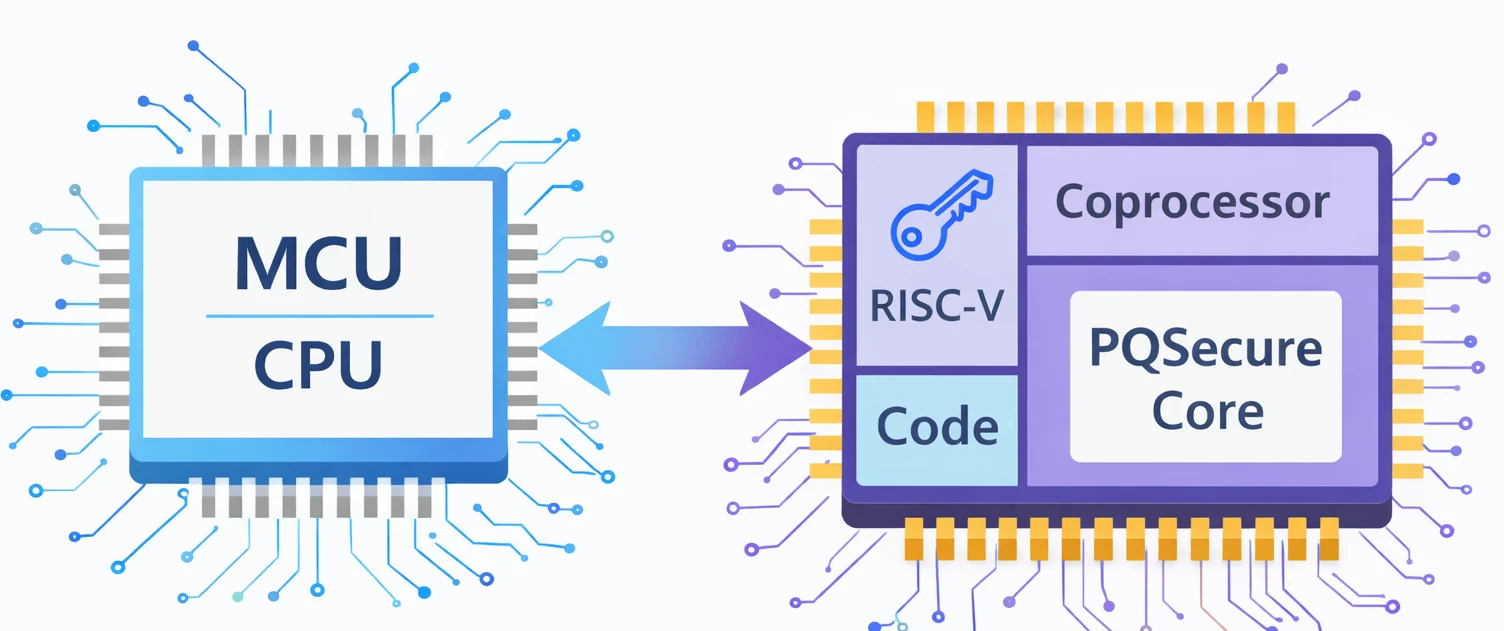
The co-design pattern is the same in both: a processor doing general work beside a cryptographic core doing the part that needs to be fast and protected.
-
Architecture
RISC-V
Secure enclaves, sovereign silicon, and next-generation defense microelectronics
- Attachment
- Accelerators over AXI or APB
- Boot
- Secure Boot ROM integration
- Extensions
- Custom cryptographic instructions, optional
- Scaling
- Lightweight MCU up to secure SoC
-
Architecture
ARM
Embedded and high-performance systems migrating to post-quantum
- Cortex-M
- Secure firmware acceleration
- Cortex-A
- High-performance deployments
- TrustZone
- Secure world integration
- Keys
- Hardware-backed provisioning
From first instruction to stored key
A typical co-designed root of trust, in the order a boot actually traverses it. The accelerator tier is chosen per design, using the same four profiles the hardware IP offers.
-
Processor RISC-V or ARM application core
-
Secure Boot ROM Immutable first-stage verification
-
PQC hardware accelerator Tiny, Compact, Balanced, or High-Performance tier
-
libpqsecure firmware stack The C and Rust libraries, in firmware
-
Secure key storage and TRNG CAVP-validated RBG for key generation and reseeding
Entropy from source to key
Randomness is part of the security boundary. PQSecure’s hardware RBG brings the entropy source, standards-based conditioning, deterministic generation, and software interface into one validated path.
TRNG and RNG architecture
- TRNG and conditioning
-
The hardware TRNG captures physical noise inside the trust boundary, then applies an AES-CBC-MAC conditioning component validated to NIST SP 800-90B.
- Deterministic generation
-
Conditioned entropy feeds a CTR-DRBG using AES-256, validated to NIST SP 800-90A, for controlled high-rate random-bit generation.
- Validated hardware implementation
-
PQSecure Hardware RBG Core version 1.0 is validated under CAVP certificate A8932 on the AMD Artix-7 XC7A100T operating environment.
- Hardware/software boundary
-
The interface defines how entropy is requested, reseeded, monitored, and isolated across the processor, secure boot firmware, key storage, and PQC accelerator.
Certification
 A8932
Cryptographic Algorithm Validation Program
A8932
Cryptographic Algorithm Validation Program
A validated random-bit generation path combining hardware entropy, SP 800-90B conditioning, and an SP 800-90A deterministic random bit generator.
- Validated
-
- AES-CBC-MAC conditioning SP 800-90B
- CTR-DRBG AES-256 SP 800-90A
- Vendor
- PQSecure Technologies
Validated for the AMD Artix-7 XC7A100T operating environment. First validated September 4, 2026.
Protected in silicon, proven in software, checked by others
An architecture is only as sound as its weakest layer, so hardening, verification, and independent evaluation each cover a different one.
Security and assurance
-
Hardware
The accelerator and the silicon around it
Protections
- Side-channel-hardened accelerators
- Masking and leakage protections
- Fault injection mitigation
- CAVP A8932 hardware random-bit generation
-
Software
The firmware stack running on the core
See the software stack →Protections
- Formally verified C and Rust implementations
- Constant-time enforcement
- Secure update workflows
-
Independent evaluation
Assessment by someone other than the designer
Hardware evaluation detail →Assessed by
- Third-party security testing
- Keysight DPA and CPA assessment
- Robustness under adversarial conditions
Where it goes
Built for programs where the silicon ships once and has to stay defensible for the whole of its service life. What ships is more than cryptographic IP: it is a migration-ready architecture.
Engineered for
- Defense and aerospace
- Secure boot and Root-of-Trust
- RISC-V and ARM SoCs
- Long-lifecycle infrastructure
- Supply-chain-assured silicon
We combine
- Crypto agility engineered at design time
- OTA-ready modernization
- RISC-V and ARM integration
- Complete PQC coverage
- Side-channel protected hardware
- Formally verified software
so that today’s silicon stays secure in tomorrow’s quantum world.
Architectures that can outlive their algorithms.
Talk with our team about integrating hardware acceleration and a verified software stack into your SoC.
Contact us