


Quantum-safe secure boot
PQSecure™-Boot is designed for constrained Root-of-Trust environments, combining verify-only optimization, low footprint, and multi-algorithm quantum-safe authentication and attestation. It is available in both hardware and software implementations.
Signature algorithms
| Module | Standard | Type |
|---|---|---|
| ML-DSA | FIPS 204 | Lattice |
| LMS | RFC 8554 | Stateful hash |
| SLH-DSA | FIPS 205 | Stateless hash |
The first thing that runs has to be the right thing
Secure boot is the foundation of trust in a connected system. PQSecure™-Boot verifies that only authentic, authorized firmware or operating system images execute at startup, in either software or silicon depending on where the trust anchor lives.

One job, two places to do it
The same quantum-safe verification, delivered as a software library for existing processors or as hardware IP for a silicon Root-of-Trust. Both support the same three signature algorithms.
Implementations
-
PQSecure™-Boot-SW
Software libraries for embedded processors, bootloaders, and firmware
Verified with
- NIST ACVP certified for all algorithms
- PSA Certified APIs
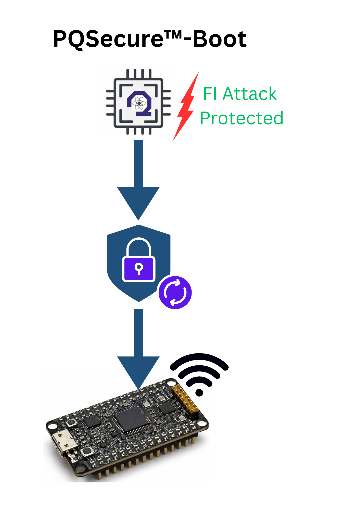
- Fault injection protection
Implementation
- C and Rust, under 5 KB RAM
- ML-DSA, LMS, and SLH-DSA verification flows
- Deploys on existing processor platforms
Used for
- Secure boot and firmware verification
- Secure update
-
PQSecure™-Boot-HW
Hardware IP for ASIC, FPGA, SoC, and secure enclave integration
Verified with
- FIPS compliant, certified under ACVP
- Optional fault injection protections
Implementation
- Under 35 kGE at 65 nm, above 500 MHz
- Integrated hashing and flexible memory architectures
- ML-DSA, LMS, and SLH-DSA
Deploys on
- ASIC, FPGA, and SoC platforms
- Root-of-Trust and secure enclave architectures
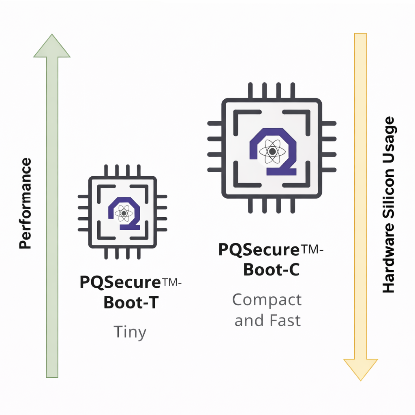
Two hardware variants
The hardware IP trades silicon area against verification speed, so the same Root-of-Trust design fits a tightly constrained die or a part that has area to spend.
-
Hardware variant
Boot-T
Tiny
- Silicon area
- Smallest, under 35 kGE at 65 nm
- Performance
- Lower than Boot-C
- Frequency
- Above 500 MHz on target technology
-
Hardware variant
Boot-C
Compact and fast
- Silicon area
- Larger than Boot-T
- Performance
- Higher verification throughput
- Deploy on
- ASIC, FPGA, and SoC
Verification is the operation that matters
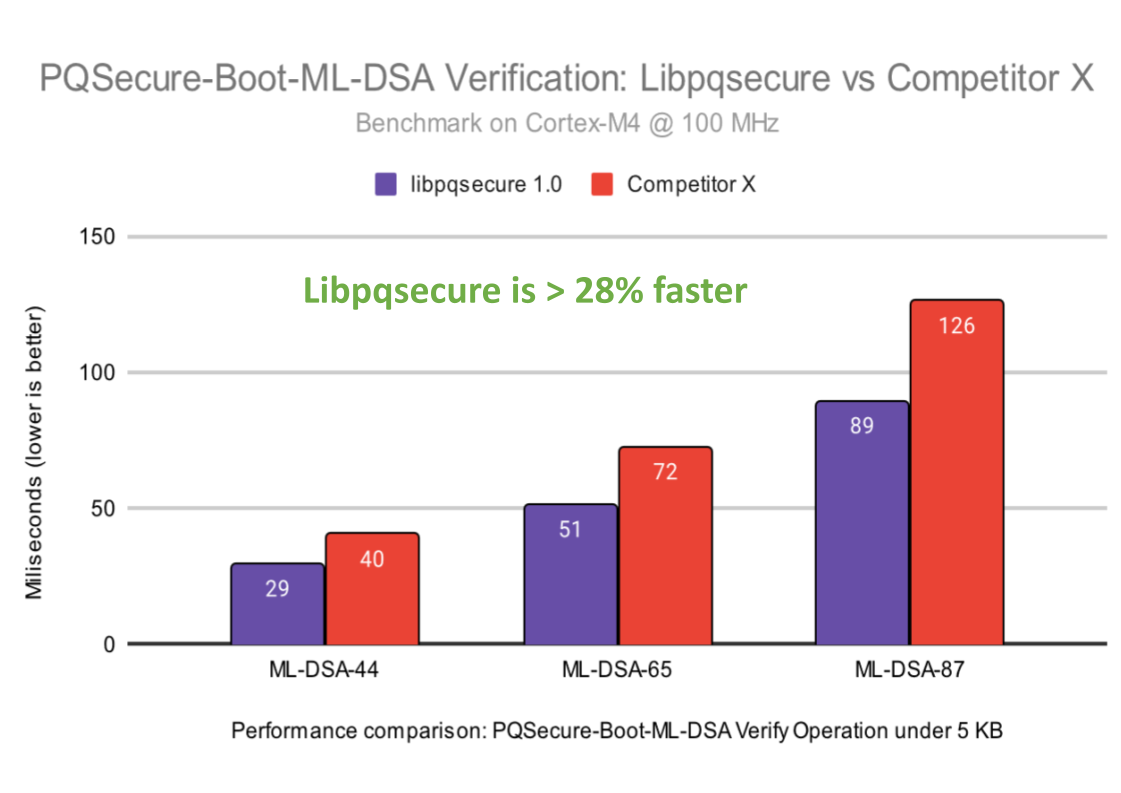
A boot chain verifies far more often than it signs, so PQSecure™-Boot is optimized for the verify path. Measured on a Cortex-M4 at 100 MHz, in under 5 KB.
Where it goes
Built for platforms whose firmware has to stay verifiable for as long as the hardware is in service.
Engineered for
- Embedded devices and IoT products
- Secure processors and Root-of-Trust
- FPGA prototypes and ASIC implementations
- Defense and aerospace platforms
- Automotive and industrial systems
- Long-lifecycle platforms
We combine
- Multi-algorithm quantum-safe authentication
- Software and hardware implementations
- High performance and low latency
- Ultra-low footprint
- Fault injection resistance
- Formally verified
to deliver quantum-safe secure boot from the first instruction.
Trust that starts before the firmware does.
Talk with our team about Root-of-Trust integration, target platforms, and whether the hardware or software path fits your design.
Contact us