PQSecure-SW™
High-Assurance Post-Quantum Cryptography Software
PQSecure-SW™ delivers production-grade, side-channel-aware, formally verified post-quantum cryptography software for embedded systems, secure boot, Root-of-Trust, defense platforms, and silicon-integrated deployments.
Our modular software stack includes:
- libpqsecure-C – High-assurance portable C implementation
- libpqsecure-rs – Memory-safe pure Rust implementation
- libpqsecure-asm – Architecture-optimized assembly acceleration layer
Together, they provide portable, high-performance, quantum-safe cryptography engineered for real-world deployment.
Algorithms Supported
PQSecure-SW™ implements finalized NIST standards, forthcoming standards, stateful hash-based signatures, and classical primitives required for hybrid deployments.
NIST Post-Quantum
- FIPS 180 – SHA-2
- FIPS 203 – ML-KEM
- FIPS 204 – ML-DSA
- FIPS 205 – SLH-DSA (SPHINCS+)
- FIPS 206 – FN-DSA (Falcon) (available soon)
- FIPS 202 – SHA-3 (Keccak)
Stateful Signatures
- RFC 8391 – XMSS
- RFC 8554 – LMS
- NIST SP 800-208 – Stateful Hash-Based Signatures
Classical Hash Standards
- RFC 6234 – SHA-2, HMAC, HKDF
All implementations support relevant NIST security levels (1, 3, 5 where applicable) and are engineered for embedded, aerospace, defense, 5G, IoT, secure elements, and supply-chain-assured silicon deployments.
Background: Transition to Post-Quantum Cryptography
With the publication of FIPS 203, 204, 205, and the upcoming FIPS 206, the migration from RSA and ECC to quantum-safe cryptography has entered full deployment. Federal mandates (including CNSA 2.0 guidance) require adoption of NIST-standardized PQC algorithms in secure communications, firmware authentication, and Root-of-Trust systems.
Secure deployment requires more than algorithm compliance. It requires:
- Constant-time implementations
- Side-channel-aware design
- Formal verification
- Stack-aware embedded optimization
- Hardware integration readiness
PQSecure-SW™ is engineered specifically for these high-assurance environments.
Software Stack Architecture
🔷 libpqsecure-C
High-assurance portable C implementation optimized for firmware, RTOS, secure boot, and silicon integration.
Key Features
- Pure C implementation
- Formally verified using CBMC
- Strict constant-time discipline
- Stack-optimized variants
- ACVP-tested infrastructure
- Portable across major toolchains
- Supports bare-metal, RTOS, and embedded Linux
- Portable across Linux, macOS and Windows
🦀 libpqsecure-rs
Memory-safe Rust implementation designed for embedded and security-critical deployments.
Key Features
- Pure Rust implementation
no_stdsupport- Formally verified using Kani
- Strict constant-time design
- Memory-safe by construction
- ACVP-tested infrastructure
- Portable across Linux, macOS, Windows, RISC-V, ARM Cortex-M
⚡ libpqsecure-asm
Architecture-specific assembly acceleration layer delivering maximum performance on constrained MCUs and high-performance processors.
Optimized Backends
- ARM Cortex-M3
- ARM Cortex-M4 / M33
- ARM Cortex-A series
- RISC-V (RV32 / RV64)
- x86-64
Capabilities
- Optimized NTT implementations
- Modular arithmetic & Polynomial multiplication acceleration
- SHA acceleration (where supported)
- Strict constant-time assembly primitives
- DSP instruction utilization (M4/M33)
- Optional vector acceleration (AVX2 / NEON)
libpqsecure-asm integrates seamlessly with both libpqsecure-C and libpqsecure-rs.
Code-Size Configuration Options
PQSecure-SW™ supports two deployment profiles:
🚀 Large Variant (Performance)
- Maximum throughput
- Stack-optimized implementations
- Three ML-DSA sign stack/performance tradeoffs
- Ideal for large and medium sized devices, gateways, defense systems
🔒 Small Variant (Code Footprint)
- Reduced stack usage
- Lower performance than Large variant
- Ideal for constrained MCUs and secure elements
Formal Verification & Assurance
PQSecure-SW™ integrates formal methods directly into production cryptographic software.
- Rust verified using Kani
- C verified using CBMC
- Constant-time coding discipline
- Side-channel-aware implementation
- ACVP testing infrastructure
- Designed for FIPS-oriented validation pathways
Continuous Integration & Embedded Validation
PQSecure-SW™ includes production-grade CI infrastructure:
- Linux / macOS / Windows testing
- RISC-V and ARM via QEMU
- On-board embedded validation
- Automated regression testing
- crypto-repo: OS + Qemu validation
- board-repo: Embedded evaluation boards
- crypto-board-repo: automated cloning + board regression
Why PQSecure-SW™
Engineered specifically for:
- Embedded environments
- Secure boot & Root-of-Trust
- Defense & aerospace systems
- Silicon integration
- Hardware / software co-design
We combine:
- NIST compliance
- Formal verification
- Constant-time discipline
- Assembly-level optimization
- Embedded portability
- Hardware acceleration readiness
to deliver production-ready, high-assurance quantum-safe cryptography.
Sample Performance Benchmark Results & Comparisons
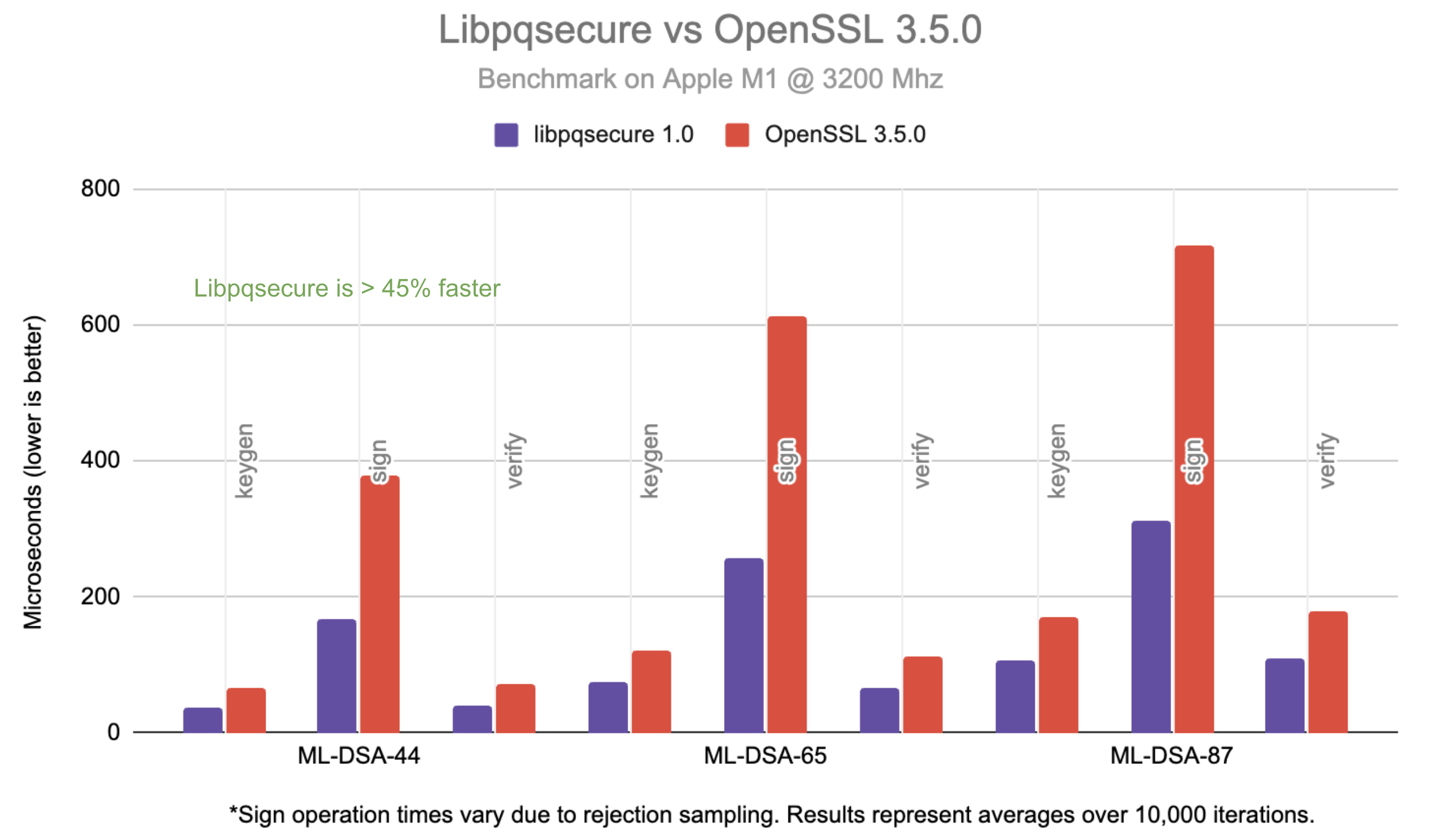
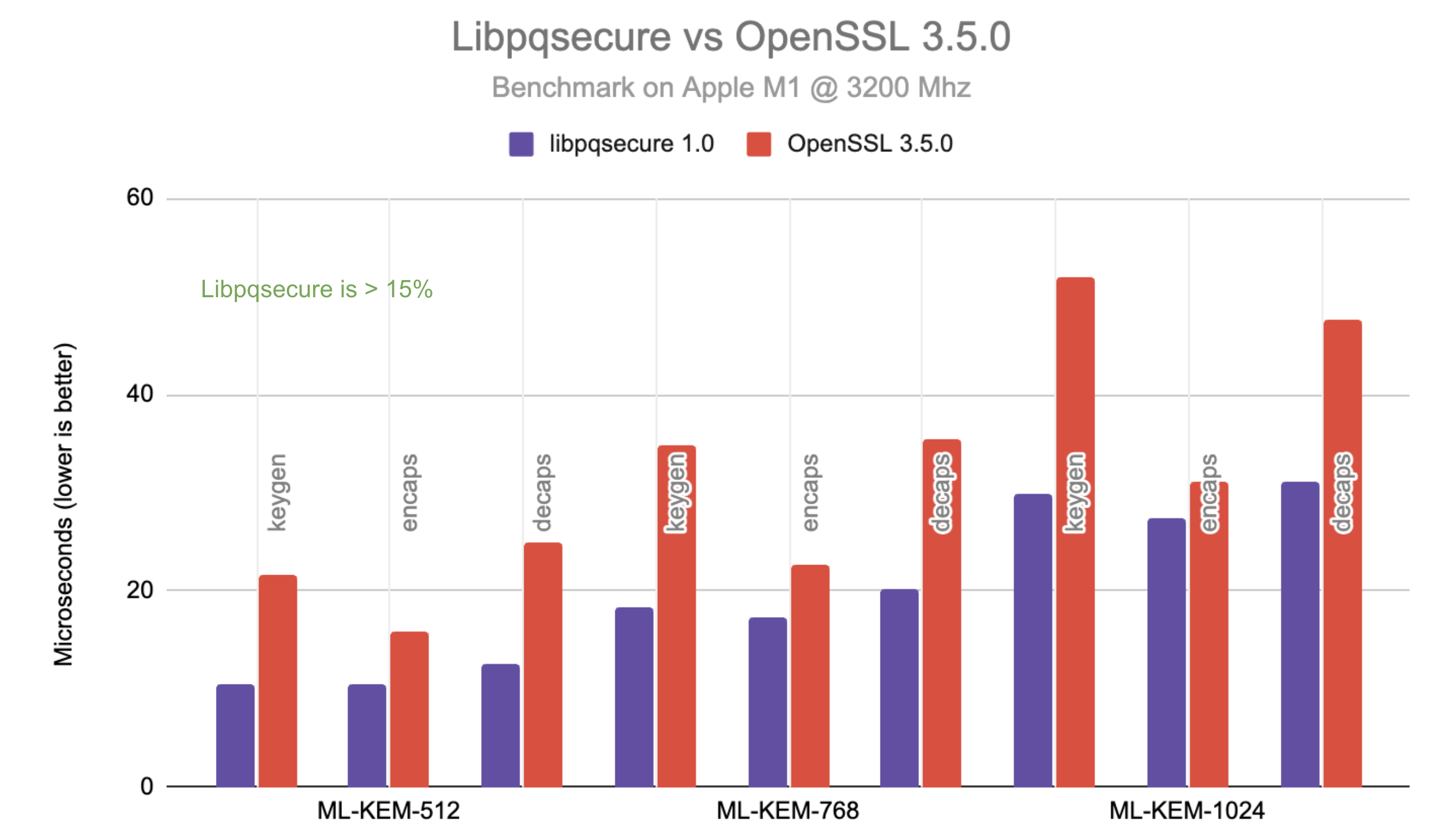
The above benchmarks compare libpqsecure 1.0 against OpenSSL 3.5.0 on an Apple M1 processor @ 3.2 GHz. Results are reported in microseconds (lower is better).
Across all tested parameter sets of FIPS 203 (ML-KEM) and FIPS 204 (ML-DSA), libpqsecure consistently demonstrates measurable performance advantages.
ML-KEM (FIPS 203)
- libpqsecure shows >15% lower latency across key generation, encapsulation, and decapsulation.
- Performance gains increase with higher security levels (ML-KEM-768 and ML-KEM-1024).
- Optimized NTT and polynomial arithmetic pipelines contribute to reduced execution time.
ML-DSA (FIPS 204)
- libpqsecure achieves >45% faster signing performance compared to OpenSSL.
- Verification and key generation also show consistent improvements.
- Optimizations include constant-time arithmetic, stack-aware tuning, and reduced memory movement.
Note: ML-DSA signing performance reflects average results over 10,000 iterations due to rejection sampling variability.
These results demonstrate that PQSecure-SW™ is not only standards-compliant and formally verified, but also engineered for high-performance production deployments.
NIST CAVP/ACVP Compliance/Certifications
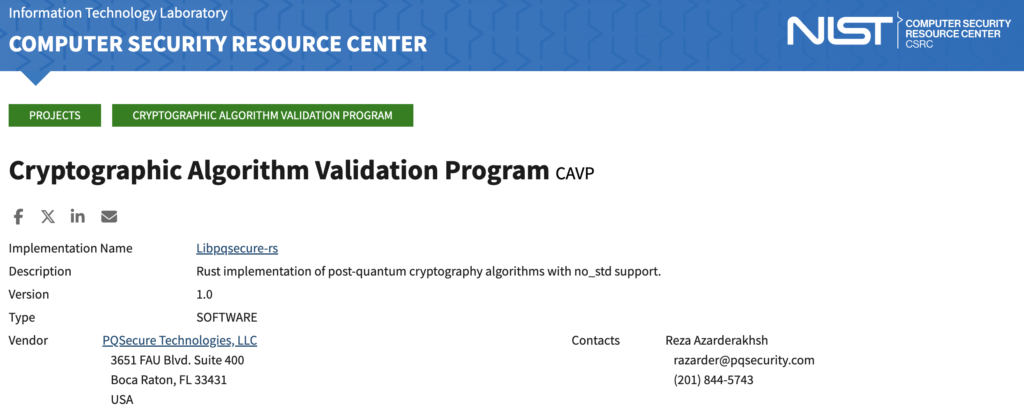
libpqsecure-c
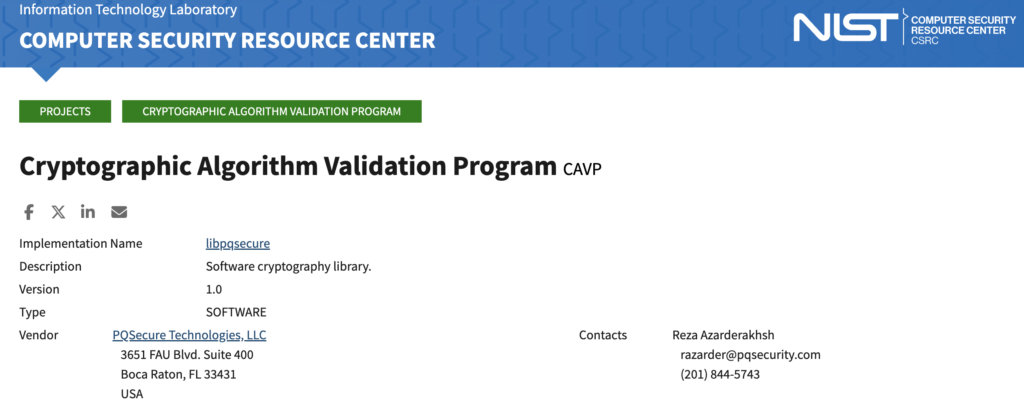
libpqsecure-rust