

Cryptographic software stack
PQSecure-SW™ delivers production-grade, side-channel-aware, formally verified post-quantum cryptography software for embedded systems, secure boot, Root-of-Trust, defense platforms, and silicon-integrated deployments.
Software stack
| Module | Implementation | Verified with |
|---|---|---|
| libpqsecure-C | Portable C for firmware, RTOS, secure boot, and silicon integration | CBMC |
| libpqsecure-rs | Memory-safe Rust, no_std capable |
Kani |
| libpqsecure-asm | Architecture-optimized assembly acceleration | Constant-time primitives |
Algorithm coverage
The finalized NIST standards, the forthcoming ones, stateful hash-based signatures, and the classical hash primitives that hybrid deployments still depend on.
Complete portfolio
NIST post-quantum
- ML-KEM FIPS 203
- ML-DSA FIPS 204
- SLH-DSA (SPHINCS+) FIPS 205
- FN-DSA (Falcon) FIPS 206, available soon
Stateful signatures
- XMSS RFC 8391
- LMS RFC 8554
- Stateful guidance NIST SP 800-208
Hash and classical
- SHA-2 FIPS 180
- SHA-3 (Keccak) FIPS 202
- SHA-2, HMAC, HKDF RFC 6234
Implementations support the relevant NIST security levels, 1, 3, and 5 where applicable.
Three modules, one stack
Portable C, memory-safe Rust, and an assembly acceleration layer that integrates with both. Use them together or independently.
Modules
-
libpqsecure-C
Portable C for firmware, RTOS, secure boot, and silicon integration
Verified with
- Formally verified using CBMC
- Strict constant-time discipline
- ACVP-tested infrastructure
Implementation
- Pure C implementation
- Stack-optimized variants
- Portable across major toolchains
Runs on
- Bare-metal, RTOS, and embedded Linux
- Linux, macOS, and Windows
-
libpqsecure-rs
Memory-safe Rust, published as PQSecure™-TRUST
Verified with
- Formally verified using Kani
- Strict constant-time discipline
- ACVP-tested infrastructure
Implementation
- Pure Rust implementation
- Memory-safe by construction
no_stdsupport
Verification detail on TRUST →Runs on
- RISC-V and ARM Cortex-M
- Linux, macOS, and Windows
-
libpqsecure-asm
Architecture-optimized assembly acceleration for both libraries
Accelerates
- Optimized NTT implementations
- Modular and polynomial arithmetic acceleration
- SHA acceleration where supported
- DSP instruction utilization on M4 and M33
- Optional AVX2 and NEON vector acceleration
Targets
- ARM Cortex-M3, Cortex-M4 and M33, Cortex-A series
- RISC-V RV32 and RV64
- x86-64
Formal methods, in production code
Verification is part of the build rather than a report written afterwards, and it runs continuously across desktop, emulated, and real embedded targets.
Assurance
- Verification and assurance
-
- Rust verified using Kani
- C verified using CBMC
- Constant-time coding discipline
- Side-channel-aware implementation
- ACVP testing infrastructure
- Designed for FIPS-oriented validation pathways
- Continuous integration
-
- Linux, macOS, and Windows testing
- RISC-V and ARM via QEMU
- On-board embedded validation
- Automated regression testing
- Embedded validation
-
Three repositories carry the work: crypto-repo for operating system and QEMU validation, board-repo for embedded evaluation boards, and crypto-board-repo for automated cloning and board regression.
Performance and footprint
libpqsecure 1.0 measured against OpenSSL 3.5.0 on an Apple M1 at 3.2 GHz, results in microseconds, then offered in two deployment profiles so the same library fits a gateway or a secure element.
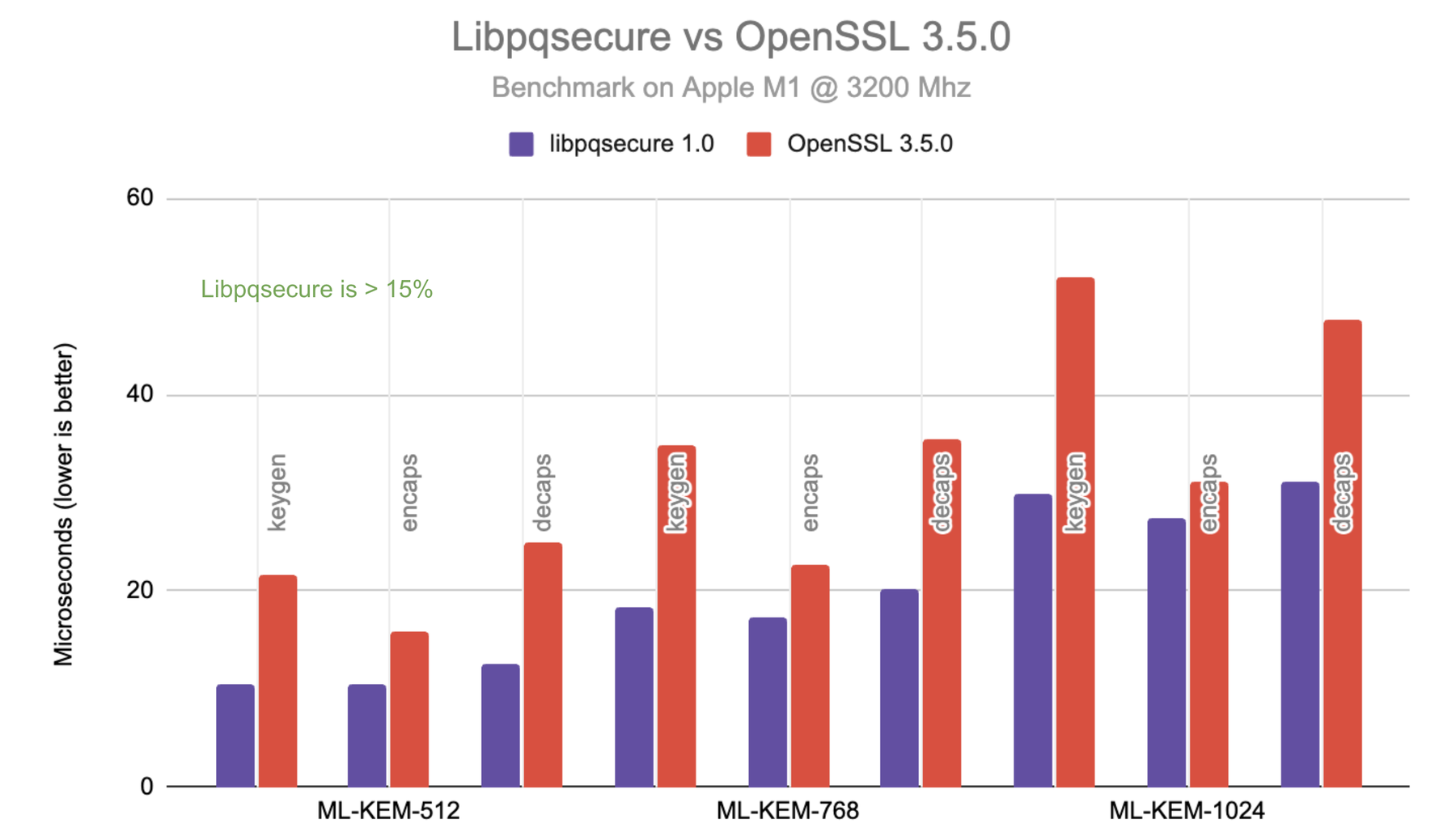
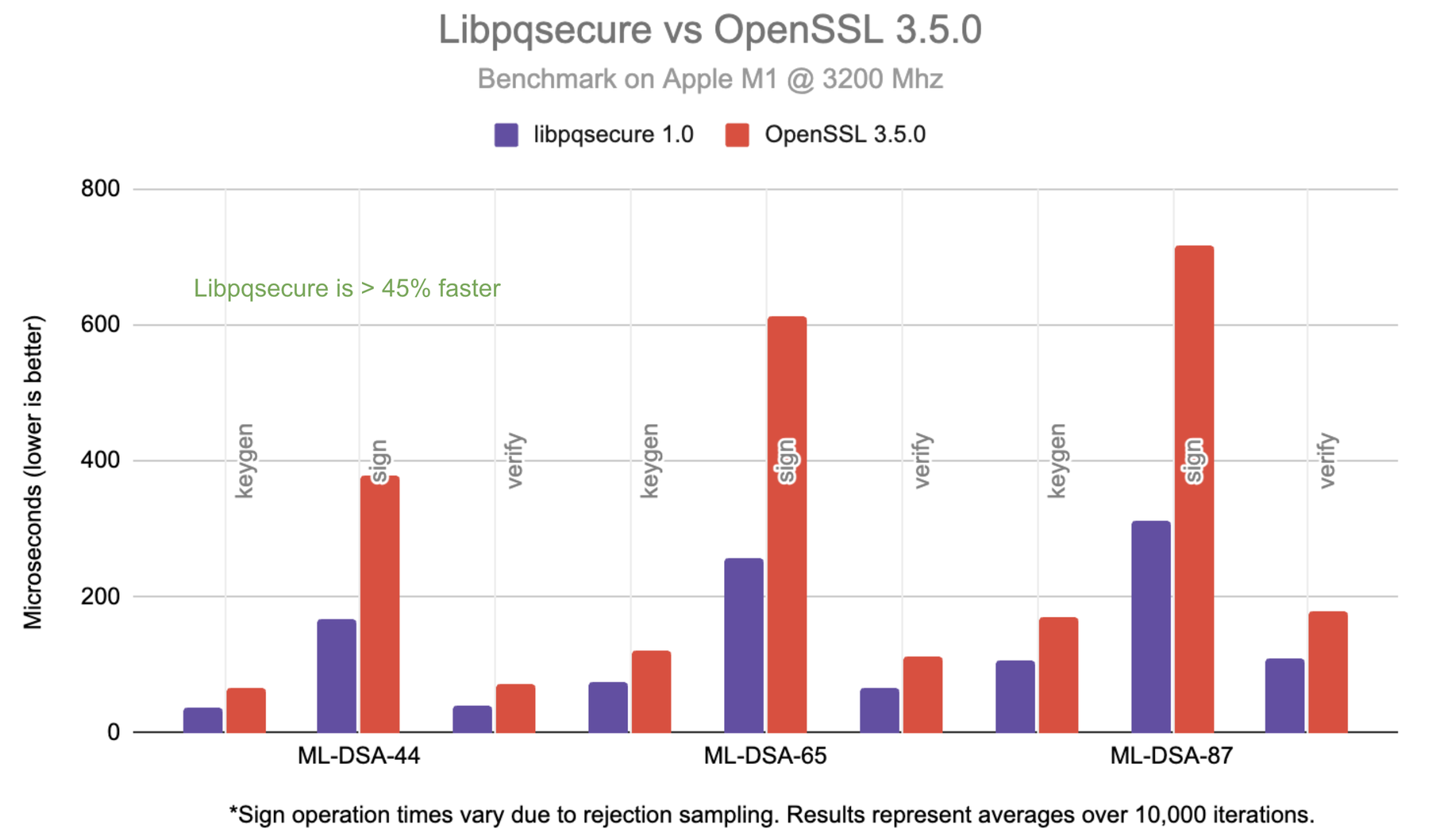
Lower is better. ML-DSA signing is averaged over 10,000 iterations because rejection sampling makes individual runs variable. Gains come from optimized NTT and polynomial arithmetic, constant-time arithmetic, stack-aware tuning, and reduced memory movement.
-
Deployment profile
Large
Tuned for performance
- Throughput
- Maximum
- Stack
- Stack-optimized implementations
- ML-DSA signing
- Three stack and performance tradeoffs
- Deploy on
- Large and medium devices, gateways, and defense systems
-
Deployment profile
Small
Tuned for code footprint
- Throughput
- Lower than the large variant
- Stack
- Reduced stack usage
- Deploy on
- Constrained MCUs and secure elements
Where it goes
Engineered for environments where cryptography ships inside the product, and backed by evidence that can be checked rather than described.
Engineered for
- Embedded environments
- Secure boot and Root-of-Trust
- Defense and aerospace systems
- Silicon integration
- Hardware and software co-design
We combine
- NIST compliance
- Formal verification
- Constant-time discipline
- Assembly-level optimization
- Embedded portability
- Hardware acceleration readiness
to deliver production-ready, high-assurance quantum-safe cryptography.
Pairs with PQSecure-HW cores →Certification
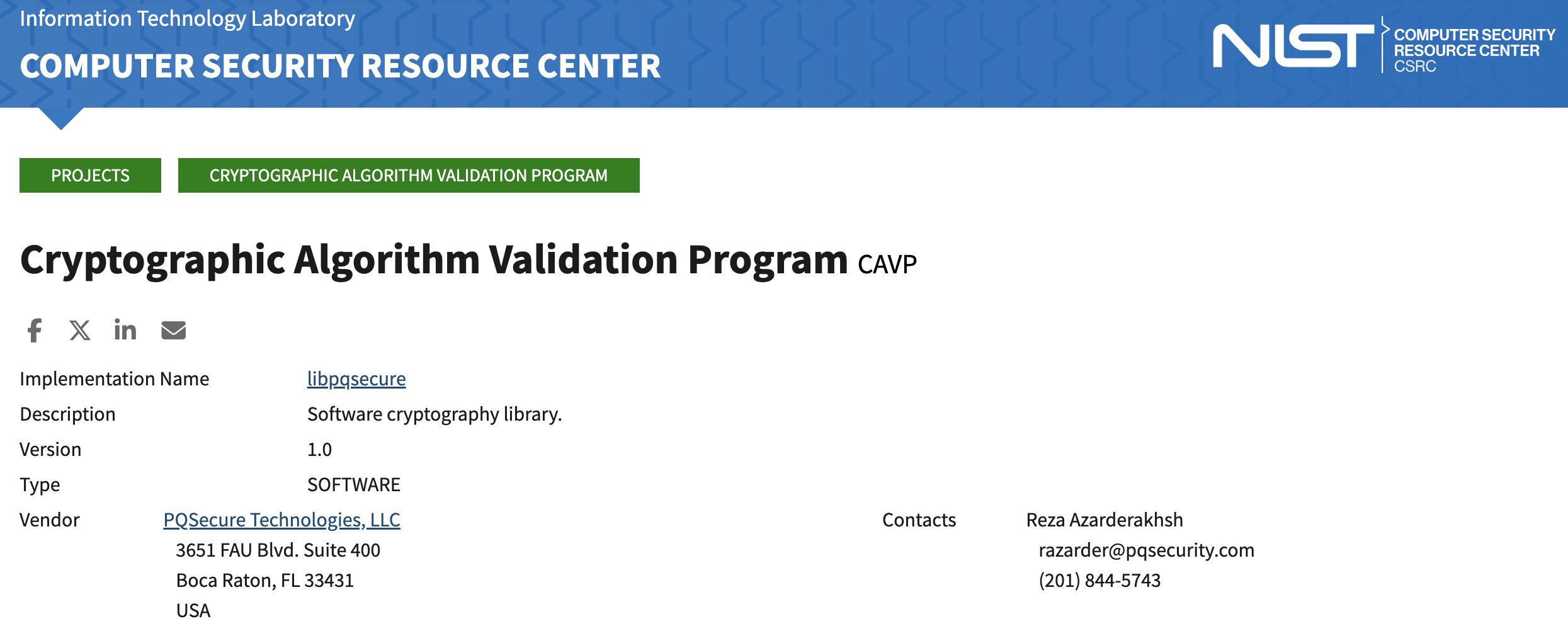
 A6936
Cryptographic Algorithm Validation Program
A6936
Cryptographic Algorithm Validation Program
libpqsecure-c, validated as a software cryptographic library.
- Validated
-
- ML-KEM FIPS 203
- ML-DSA FIPS 204
- SLH-DSA FIPS 205
- Vendor
- PQSecure Technologies
The Rust implementation is certified separately under A7616. See PQSecure-TRUST →
Quantum-safe cryptography your firmware can carry.
Talk with our software team about integration, target platforms, code-size budgets, and licensing.
Contact us